
Do these 3 things before closing this tab:
1Fix the driver behind crashes, sound loss and screen glitches2Clear out junk files and repair common Windows errors3Scan for outdated or missing drivers - takes under a minuteAnglerfish adapt to the deep ocean by combining energy-saving ambush hunting, a specialized lure, sensitive nonvisual senses, pressure-tolerant body structures, and unusual reproductive strategies. Many deep-sea anglerfish use a fleshy, sometimes bioluminescent lure to bring prey within reach instead of spending precious energy searching for it. Their expandable mouths help them take advantage of rare meals, while dark bodies help limit reflection in near-total darkness.
However, “anglerfish” does not describe just one kind of fish. The order Lophiiformes contains more than 300 species, including shallow-water and seafloor-dwelling forms. The most dramatic adaptations—including the famous glowing lure and permanently attached male—belong mainly to deep-sea ceratioid anglerfish.
As an Amazon Associate I earn from qualifying purchases.
The deep ocean creates unusual survival problems
Deep-sea anglerfish live in an environment that is cold, dark, under intense pressure, and far removed from the surface waters where most ocean food production begins. In the bathypelagic zone, prey may be widely scattered and encounters can be unpredictable. Swimming continuously to search for food would be costly, and finding a mate could be equally difficult when individuals are dispersed through a vast, dark habitat.
The Tool Desk
Outbyte PC Repair FREERepair Windows errors before they cause bigger problemsFix Now →Outbyte Driver Updater FREEFix the driver behind crashes, sound loss and screen glitchesFind Drivers →The anglerfish’s adaptations address those problems in several connected ways:
#1 Best Overall
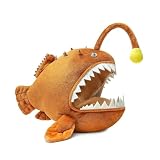
- Cute Anglerfish Design: Inspired by the unique look of deep sea anglerfish, this plush toy features detailed fins, a rounded body, and a playful appearance that adds fun to ocean-themed play and room decoration
- Soft Plush Material: Made with plush fabric and PP cotton filling for a soft and cuddly touch, lightweight and comfortable for hugging, carrying, or relaxing during quiet time
- 10 Inch Portable Size: Measures approximately 10 inches, making it easy for kids to hold, display on beds or shelves, or take along for travel, sleepovers, and everyday play
- Imaginative Play Companion: Suitable for storytelling, pretend play, and ocean animal learning activities, helping children enjoy creative adventures while adding a fun sea life element to playtime
- Gift And Decoration Choice: Suitable for birthdays, Christmas, Valentine’s Day, Children’s Day, and other special occasions, this anglerfish plush also works well as a playful decoration for bedrooms, nurseries, and reading corners
- Find prey efficiently: use a lure and ambush tactics rather than prolonged pursuit.
- Make rare meals count: seize large or unexpected prey with a large mouth, sharp teeth, and elastic tissues.
- Stay difficult to detect: reduce body reflection with dark coloration.
- Sense nearby animals: rely on specialized vision, smell, and possibly water movement rather than sunlight-dependent sight.
- Conserve energy: minimize unnecessary swimming and prey-searching.
- Reproduce despite scarce encounters: use strong sexual dimorphism and, in some species, permanent male attachment.
These traits are not a single universal anglerfish package. Different lineages have evolved different solutions to different depths, habitats, and hunting styles.
1. A modified fin becomes a built-in fishing lure
In many familiar deep-sea anglerfish, the first ray of the dorsal fin has been transformed into a flexible stalk called the illicium. At its tip is a fleshy structure called the esca. The fish can position this structure in front of its mouth, where it acts as a lure.
In many species, the esca produces light through a partnership with bioluminescent bacteria. The bacteria live in the light-producing organ, creating a small glowing signal in an otherwise dark environment. The anglerfish can then wait with minimal movement while curious prey approach the apparent source of light.
This is an energy-saving hunting method. In a food-poor habitat, the fish does not have to spend as much energy swimming through open water looking for prey or chasing it over long distances. Instead, the lure helps bring an opportunity into striking range.
The relationship with the bacteria is also significant. Research indicates that luminous bacteria are acquired from the environment rather than passed directly from parent to offspring. That arrangement fits the life cycle of deep-sea ceratioids: young fish begin as planktonic larvae near the surface and later descend into the deep ocean, where they encounter the conditions and microbes associated with their adult lifestyle.
Not every anglerfish has a classic glowing lure. Some deep-sea families produce light in different ways, and some anglerfish lack the familiar luminous structure altogether. “Many deep-sea anglerfish” is therefore more accurate than “all anglerfish.”
2. Ambush feeding makes scarce food worthwhile
A lure would be of little use without a mouth adapted to capture prey quickly. Deep-sea anglerfish commonly have large mouths and sharp, pointed teeth. Their teeth can help secure animals that may be difficult to hold in the darkness and may prevent prey from escaping once it has entered the mouth.
Many also have elastic tissues, including an expandable stomach, that allow them to swallow substantial meals when an opportunity appears. This is an adaptation to opportunistic feeding: rather than expecting regular meals, the fish is equipped to exploit an unpredictable encounter.
Rank #2

- 🐡Material: Premium plush+ pp cotton. Safe material, more hugs for children.
- 🐡Size: Wide about 11inch.
- 🐡Feature: This is lifelike toy, imitates real wild animals.
- 🐡Use: Cute style for gift, exquisite and cute plush toy animal collection, home decoration.
- 🐡Gift: Exquisite children baby gift, wonderful animal collection fans gift.
That does not mean every anglerfish routinely swallows prey larger than itself, or that all species have the same feeding capacity. The useful general point is that a large gape and flexible digestive region help a predator make the most of infrequent meals.
3. Dark coloration reduces unwanted reflection
Although the deep sea lacks sunlight, it is not completely without light. Many animals produce brief flashes or glows through bioluminescence. Against that background, a reflective body could reveal a predator to prey or make the anglerfish easier for another animal to detect.
Many deep-sea anglerfish are dark brown or black. This coloration likely reduces reflection and helps keep the body inconspicuous when stray light is present. It is better understood as low reflectance or camouflage than as perfect invisibility.
Free tools Windows power users keep installed
One-click scans. No signup required.
The lure creates an important trade-off. The esca must be visible enough to attract prey, but the rest of the fish benefits from remaining difficult to see. The anglerfish’s hunting system therefore combines a conspicuous signal at one end of the body with a relatively inconspicuous body behind it.
4. Their senses are suited to darkness and rare encounters
Anglerfish are not simply blind fish. Their eyes and other sensory structures vary among lineages, and visual dependence differs between species. Deep-sea forms, however, cannot depend on ordinary daylight vision in the way a surface fish can.
The lure supplies a close-range visual signal for attracting prey. Other senses can help the fish detect animals nearby. Some anglerfish appear able to sense disturbances or the displacement of water caused by an approaching animal, a useful ability for a predator that waits rather than pursues.
Sensory adaptations are especially important for males. In many deep-sea ceratioids, males are tiny compared with females and have very large nostrils or other enlarged olfactory structures. Smell helps a free-swimming male locate a female in the dark, where visual contact may be difficult and individuals may be far apart.
These features should be treated as species-dependent rather than universal. Anglerfish lineages differ considerably in anatomy, habitat, and behavior.
Rank #3

- PREMIUM PLUSH MATERIALS: Our stuffed luminous anglerfish plush toy is made from child-safe materials. From the outer fabric to the inner stuffing, 100% handmade, with meticulous stitching. The quilt cover of the toy is made of high-quality plush fabric . The inner th ick PP cotton is filled. Parents don't have to worry about toys irritating their children's skin. Your child can play and have fun at will. The soft marine life toy can be used as a birthday gift or as sleeping partner.
- REALISTIC Anglerfish PLUSH TOY: This blue night-shining anglerfish goosefish toy, imitates real marine animals. The adorable face and squeezeable body of our Anglerfish plush are made from premium cloth and filler. its the brown fur and big lips is smooth and soft, movable antenna design, big luminous eyes, the overall shape design is realistic, and the face design is unique, very realistic.
- ANIMAL HUG: The head and eyes of this anglerfish plushie glow in the dark. The size of Anglerfish is about 12x8x6 inches. Super Soft Realistic Lanternfish Ocean Animal Toy are Interesting, very suitable for hugging and carrying. The hug toys are so cute! A premium gift suitable for both adults and children, because everyone needs a good animal hug from time to time. They will love this comfortable and cute Anglerfish toy.
- INNOVATIVE GIFT CHOICE: Our lovable sea life anglerfish toy will make a wonderful addition to your assembly of plushies. The realistic Anglerfish stuffed toy will be loved by sea creatures animal lovers. It's no different from real animals, and it can also be used as a great collection. Best choice for birthdays, Valentine's Day gifts, Christmas, Thanksgiving or any other anniversary.
- TRUSTED QUALITY: A handmade plush toy who has all the passion and love we provide for toys. That is why we made the toy only with super soft plush fabric and fluffy polyester cotton filling, to give it a superior quality. Contact us with any questions for fast, reliable support you can trust.
5. Ambush hunting helps conserve energy
The deep ocean places a premium on energy conservation. Food is sparse and unpredictable, while continuous swimming requires fuel. Many deep-sea anglerfish are therefore adapted for waiting, short movements, and sudden attacks rather than sustained high-speed pursuit.
The lure reduces the energetic cost of searching. Their ability to remain relatively still reduces the cost of locomotion. A large mouth and expandable stomach increase the benefit of each successful strike. Together, these traits allow an anglerfish to turn a rare feeding opportunity into a worthwhile meal.
It is tempting to summarize this by saying that all deep-sea fish have a uniformly “slow metabolism,” but that is too broad. Deep-sea animals show varied metabolic patterns. A more accurate description is that many anglerfish reduce the energetic cost of finding and pursuing prey through ambush feeding and relatively weak-swimming lifestyles.
6. Their bodies cope with pressure and buoyancy challenges
Water pressure increases greatly with depth. Gas-filled spaces that help many shallow-water fish control buoyancy become more difficult to use under those conditions. Deep-sea fish consequently show a range of anatomical and biochemical adaptations to remain functional at depth.
In anglerfish and several other deep-sea fish lineages, bones are often poorly mineralized compared with those of many shallow-water fishes. This reduced mineral content is thought to lower skeletal density and contribute to near-neutral buoyancy, helping the fish remain suspended without constant swimming.
Deep-sea animals also use biochemical adaptations involving cell membranes, pressure-tolerant proteins, and stabilizing molecules such as trimethylamine oxide, or TMAO. These mechanisms help biological structures continue working under high pressure.
Poorly mineralized bones are part of a broader pressure-and-buoyancy solution, not a complete explanation on their own. The details vary among species, and the evidence is comparative and evolutionary rather than a claim that one anatomical feature explains every anglerfish’s ability to live at depth.
Recommended Free Tools
7. Extreme differences between males and females improve reproductive odds
Many deep-sea ceratioids show extreme sexual dimorphism: females are much larger than males. A large female has room to develop and produce eggs, while a tiny male can devote more of his limited resources to finding a mate.
Rank #4

- Premium velboa fabric with double-stitched seams for long-lasting durability
- Scientifically accurate design featuring bioluminescent textures and articulated fins
- Ultra-soft PP cotton filling maintains shape after repeated hugs and displays
- Compact 25cm/9.84in size perfect for shelf displays and portable adventures
- Ideal for marine biology enthusiasts and unique underwater-themed decor
The male’s enlarged olfactory organs help him search for females in darkness. This is a major advantage in a habitat where potential partners may be rare and widely separated. Once a male finds a female, the species must still prevent the pair from being separated and avoid making the male repeat the search.
8. In some species, the male becomes a permanent reproductive partner
Some deep-sea ceratioids use an extraordinary strategy known as sexual parasitism. The small male bites onto the much larger female. Depending on the species, the attachment may be temporary or permanent.
In species with permanent attachment, the male’s tissues can fuse with the female’s. He becomes dependent on her for nutrients and remains available to provide sperm, while the female no longer needs to locate another mate in the enormous deep ocean. This turns an extremely unlikely second encounter into a reliable reproductive connection.
What’s actually slowing this PC down?
Pick the symptom - the matching free tool is one click away.
Permanent attachment is not universal among anglerfish. Other species have free-living males that locate females and meet them only for mating. Even within deep-sea ceratioids, reproductive anatomy and attachment behavior differ between lineages.
Genomic research has connected permanent sexual parasitism with major changes in genes involved in the adaptive immune system. Ordinarily, immune defenses help an animal recognize and reject foreign tissue. Modifications that reduce certain rejection responses may have helped permanent tissue fusion evolve, although the evolutionary history is complex and is not identical in every permanently parasitic lineage.
Independent reader supportYour contribution helps us test, update, and keep practical guides available for everyone.9. Different life stages use different environments
Deep-sea ceratioids do not begin life looking like the familiar adult anglerfish. Their young are planktonic larvae that live near the surface. As they mature, they descend into deeper water, where females develop the body form and lure associated with adult deep-sea anglerfish.
This developmental migration separates life stages into habitats with different light levels, currents, food supplies, and pressures. It may also explain why luminous bacteria can be acquired from the environment: the young fish and adult fish occupy different ecological settings.
Quick wins for a faster PC:
Repair Windows errors before they cause bigger problemsFix Now →Fix the driver behind crashes, sound loss and screen glitchesFind Drivers →Clear out junk files and repair common Windows errorsFree Scan →The precise life cycle is not identical across all anglerfish. The surface-to-deep-water pattern is most relevant to the deep-sea ceratioid group and should not be applied automatically to shallow-water or bottom-dwelling species.
Best Value

- 12" Length.
- Bendable antenna.
- Cute, soft and squeezable.
- High quality. Detailed realistic design.
- Designed in the USA by Adore Plush Company.
10. Anglerfish adaptations vary with habitat and hunting style
The classic round-bodied, lure-bearing anglerfish is memorable, but it represents only one part of the group’s diversity. Adaptation depends on where a species lives and how it hunts.
Whipnose anglerfishes in the genus Gigantactis, for example, have unusually long lures. They have also been observed swimming upside down, apparently positioning the lure above the seafloor. Their more streamlined bodies suggest a more active lifestyle than the familiar sit-and-wait form.
Other species have distinctive features such as chin barbels or different light-producing structures. Some have free-living males rather than permanently attached ones. These differences show why it is misleading to describe one “anglerfish adaptation” as though every member of the order has the same anatomy.
A simple way to understand the anglerfish’s survival system
| Environmental challenge | Adaptation | Survival benefit |
|---|---|---|
| Darkness and scarce prey | Illicium and esca in many deep-sea species | Attracts prey without extensive searching |
| Infrequent meals | Large mouth, sharp teeth, and elastic tissues | Improves the chance of securing and using a rare meal |
| Bioluminescent flashes | Dark, low-reflectance coloration | Helps reduce the body’s visibility |
| Low encounter rates | Strong olfactory senses, especially in males | Helps locate a mate in darkness |
| High pressure and buoyancy difficulty | Reduced skeletal mineralization and pressure-related biochemical adaptations | Supports life and suspension at depth |
| Risk of losing a rare mate | Temporary or permanent male attachment in some ceratioids | Improves the reliability of reproduction |
Frequently Asked Questions
Do all anglerfish have a glowing lure?
No. The classic luminous lure is characteristic of many deep-sea anglerfish, especially ceratioids, but anglerfish include many other lineages. Some produce light differently, and some lack the familiar glowing structure.
Are anglerfish blind?
No. Anglerfish are not universally blind. Their eyes and reliance on vision vary by species, but deep-sea forms also depend on the lure, smell, and other sensory signals in the darkness.
Outdated Drivers Are Slowing You Down
One free scan finds every outdated or missing driver and matches the right update for your exact hardware.Free scan · exact hardware matchWindows Errors? Fix Them Before They Spread
Repair common Windows errors and clear accumulated junk for a smoother, more stable PC - no reinstall needed.Free scan · no reinstallDo all male anglerfish permanently attach to females?
No. Permanent sexual parasitism occurs in some deep-sea ceratioids. Other males remain free-living and meet females only for mating.
Why does the anglerfish use a lure?
The lure attracts prey close to the mouth, allowing the fish to ambush it while spending less energy searching and swimming through a food-poor environment.
Is an anglerfish a good pet?
No. Deep-sea anglerfish are specialized wild marine animals that depend on extreme pressure, darkness, specific food, and complex life-history conditions. They are not suitable pets or ordinary home aquariums.
The Bottom Line
Deep-sea anglerfish adapt to their environment by making scarcity work in their favor: they wait instead of constantly searching, use a lure to bring prey close, swallow valuable meals efficiently, limit body reflection, sense animals and mates in darkness, and conserve energy under pressure. Their reproductive adaptations are just as striking as their feeding adaptations. But the group is diverse, so the glowing lure and permanently attached male belong to some anglerfish—not all of them.
Quick Recap
Product prices and availability are accurate as of the date/time indicated and are subject to change. Any price and availability information displayed on Amazon at the time of purchase will apply.





Leave a Reply