
Quick wins for a faster PC:
Clear out junk files and repair common Windows errorsFree Scan →Scan for outdated or missing drivers - takes under a minuteDriver Scan →Saltwater fish are fish adapted to live in water with substantial dissolved salt, especially marine water in oceans and seas. They are not a single biological class: the category includes many unrelated kinds of bony fish as well as cartilaginous fish such as sharks and rays.
What unites them is their relationship with saline water—where they live, how they regulate water and salts in their bodies, and how they obtain food and oxygen. Some remain in the open ocean or on coral reefs, while others use coastal waters, estuaries, or habitats where salinity changes during their lives.
As an Amazon Associate I earn from qualifying purchases.
Saltwater fish are defined by habitat, not appearance
“Saltwater fish” is a practical habitat-based description, not the name of a taxonomic group. Fish that fit the description can look radically different, from tiny reef gobies to streamlined tuna, flat-bodied flounders, seahorses, sharks, and rays.
In the narrow zoological sense, fish are aquatic vertebrates. Saltwater fish occur across numerous evolutionary lineages, including:
#1 Best Overall
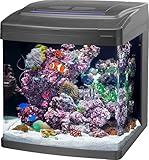
- ALL-IN-ONE SYSTEM: Everything you need for quick and easy setup. Includes a sleek and modern hood, white and blue LED lights, filter, quiet pump, dual intakes, adjustable nozzle and more.
- SMART LIGHTING: Control your aquarium from anywhere with the Aqueon BlueIQ app to toggle between white and blue LED, a programmable 24/7 schedule, feeding reminders and more.
- PERFECT FOR ALL LEVELS: Designed for both newcomers and seasoned aquarium keepers. Perfect for freshwater or saltwater environments.
- OPTIMAL GROWTH ZONES: Produces light and current within three distinct BioZones, providing the perfect light spectrum and intensity to sustain and grow different types of corals.
- PAIRS WITH BIOCUBE ACCESSORIES: Explore a range of BioCube accessories like the BioCube Protein Skimmer for advanced filtration or the Algae Cleaning Magnet and Pad for simple maintenance. Discover more options to enhance and tailor your ecosystem.
- Bony fish, which include clownfish, groupers, tunas, wrasses, flounders, seahorses, and thousands of other species.
- Cartilaginous fish, whose skeletons are made primarily of cartilage rather than bone. Sharks and rays are the best-known examples.
So a fish does not become a saltwater fish because it has a particular shape, color, or set of fins. It belongs in this broad category because it can live and function in saline aquatic environments.
Marine, brackish, and freshwater fish
The boundaries between aquatic environments are useful but not perfectly sharp. Seawater averages about 35 parts per thousand salinity—roughly 3.5 percent dissolved salts by weight—but local salinity changes with evaporation, rainfall, freshwater runoff, temperature, latitude, and ocean circulation.
| Environment | Approximate salinity | What it means for fish |
|---|---|---|
| Freshwater | Lower than brackish water | Found in rivers, lakes, and streams. The surrounding water is less salty than a fish’s body fluids. |
| Brackish water | Commonly about 0.5–30 parts per thousand | Intermediate-salinity water, often found where rivers meet the sea. |
| Saltwater or marine water | FishBase generally uses at least 30 parts per thousand for saltwater | Includes most ocean and sea habitats, although local salinity varies. |
These figures are practical definitions rather than an unchanging natural boundary. Estuaries, coastal lagoons, tidal creeks, and other transition zones can become more or less salty as tides, rainfall, and river flow change.
Some estuarine fish are marine species, some are freshwater species, and some are euryhaline species that tolerate a broad range of salinities. An estuary fish should not automatically be described as a strictly marine fish, and a marine species does not necessarily spend every stage of life in full-strength seawater.
Where do saltwater fish live?
Marine fish occupy nearly every major kind of ocean habitat. Their distribution depends on factors such as salinity, depth, temperature, dissolved oxygen, water pressure, light, nutrients, shelter, and food availability.
Nearshore and coastal waters
Nearshore fish live close to land, around rocky shores, seagrass beds, mangroves, kelp forests, tide pools, and coastal reefs. These habitats often provide shelter and concentrated food, but they can also experience substantial changes in temperature, oxygen, and salinity.
Coral reefs and other structured habitats
Clownfish, damselfish, many gobies, blennies, wrasses, angelfish, groupers, and snappers are commonly associated with reefs or other complex coastal habitats. The cracks, branches, caves, and surfaces in these environments provide places to hide, feed, reproduce, or establish territories.
Recommended Free Tools
The water column: pelagic fish
Pelagic fish live in the water column rather than on or immediately above the seafloor. Depending on the species, they may live in coastal waters or far offshore. Tunas, mackerel, sardines, anchovies, and mahi-mahi include examples of pelagic or largely open-water fish.
Pelagic species often have body shapes suited to continuous swimming, and many travel long distances to follow prey, favorable temperatures, or spawning conditions. “Pelagic” does not always mean “deep ocean”: a fish can be pelagic in relatively shallow coastal water.
Rank #2
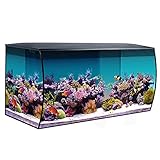
- Stylish Marine Aquarium: Contemporary design with curved front and honeycomb wrap that conceals water line and filter compartment sides
- Customizable LED Aquarium Lights: Fully adjustable 7500K White + RGB LEDs for endless color blends and plant growth support; controlled by FluvalSmart App
- Powerful Fluval Fish Tank Filtration: 3-stage filtration with oversized mechanical, chemical, and biological media for superior water quality
- Perfect Pet Supplies: Fish tank enclosure with multi-directional dual outputs for customized water flow; easy feed top cover opening
- Innovation for Fish Keepers: Fluval innovates to foster a sustainable future where aquatic life and humankind can thrive in harmony
The seafloor: demersal and bottom-associated fish
Demersal or bottom-associated fish live on, near, or closely connected to the seafloor. Flounders and halibut are familiar examples. Other bottom-associated fish use reefs, rocks, sand, mud, or vegetation as feeding and sheltering areas.
Bottom-associated does not necessarily mean a fish remains motionless on the bottom. Some species swim above it to hunt and return to it for shelter, while others are adapted to camouflage themselves against sediment or structure.
Windows Errors? Fix Them Before They Spread
Repair common Windows errors and clear accumulated junk for a smoother, more stable PC - no reinstall needed.Free scan · no reinstallCrashes, No Sound, or Screen Glitches?
Random freezes, missing sound and display glitches usually trace back to one bad driver. Find and replace yours safely.Free scan · under a minuteDeep water
Deep-sea fish must cope with high pressure, limited light, cold temperatures in many regions, and food that may be scarce or arrive unpredictably from above. These conditions favor specialized body forms, senses, feeding strategies, and metabolism. Not every deep-water fish lives in the same conditions, however; depth, temperature, oxygen, and food supply vary between locations.
How do saltwater fish survive in salty water?
The central physiological challenge is osmoregulation: controlling the balance of water and dissolved salts inside the body.
For most marine bony fish, body fluids are less salty than the surrounding seawater. Water therefore tends to leave the body by osmosis. If the fish did nothing to replace that water, it would gradually become dehydrated.
Many marine bony fish generally address this problem by:
What’s actually slowing this PC down?
Pick the symptom - the matching free tool is one click away.
- Drinking seawater to replace water lost to the environment.
- Absorbing water through the digestive system.
- Actively removing excess salts through specialized cells in the gills.
- Using the kidneys to help eliminate dissolved waste and regulate the internal chemical balance.
Freshwater fish face the broad opposite problem. Their body fluids are usually saltier than the surrounding water, so water tends to enter their bodies while salts diffuse outward. Their osmoregulatory strategies therefore emphasize removing excess water and retaining or acquiring salts.
This is a general comparison, not a rule that applies identically to every fish. Sharks and rays have different chemistry from most bony fish, and species such as salmon and eels can move between freshwater and saltwater. Their bodies adjust to changing salinity through specialized physiological mechanisms.
Examples of saltwater fish
Examples are easier to understand when organized by habitat, body type, or lifestyle:
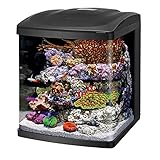
Rank #3

- 🐠 EVERYTHING YOU NEED - Feature a compact and customizable filtration chamber that is already built-in to the back of the aquarium – easy to setup and maintain
- 🐠 GREAT FEATURES – Includes quiet submersible pump, dual intakes and adjustable return nozzle. Compatible with all existing BioCube accessories. Fish, corals, substrate and décor are sold separately.
- 🐠 SLEEK & MODERN – Biocubes feature a rounded edge design and is the perfect innovative all-inclusive aquarium for all needs!
- 🐠 VIBRANT LED LIGHTING - Low-profile hood contains vibrant LED lighting that is capable of sustaining and growing healthy, vibrant corals and live plants.
- 🐠 MAXIMIZE BEAUTY - 24-hour timer which makes it easy to control the three independent light channels for maximum beauty: bright white, sparkling blue and color enhancing LEDs.
- Reef-associated fish: clownfish, damselfish, groupers, snappers, wrasses, gobies, blennies, and angelfish.
- Open-water and coastal pelagic fish: tuna, mackerel, sardines, anchovies, and mahi-mahi.
- Unusual marine body forms: seahorses and pipefish, which are marine fish with specialized shapes and reproductive adaptations.
- Bottom-associated fish: flounders, halibut, and many other fish that live on or near the seafloor.
- Cartilaginous fish: sharks and rays.
These labels describe broad ecological patterns rather than permanent rules for every individual. A species may use different habitats as it grows, feed in one area and reproduce in another, or pass through waters with different salinities during migration.
What is not a saltwater fish?
“Saltwater animal” and “saltwater fish” are not interchangeable terms. The first is a broad category based on habitat; the second refers specifically to fish living in saline water.
The following animals may live in the ocean but are not fish:
- Whales and dolphins, which are mammals.
- Seals and sea lions, which are also mammals.
- Sea turtles, which are reptiles.
- Octopuses, which are mollusks.
- Crabs, which are crustaceans.
- Jellyfish, which are cnidarians.
- Corals, which are colonial cnidarians.
- Sea stars, which are echinoderms.
For example, sea stars live in saltwater but do not have the gills, scales, and fins associated with fish. They use a water-vascular system for movement and other functions. They are marine animals, not saltwater fish.
Independent reader supportYour contribution helps us test, update, and keep practical guides available for everyone.Saltwater fish in a home aquarium
Keeping saltwater fish at home means recreating more than the appearance of the ocean. A marine aquarium must maintain suitable salinity, temperature, pH, filtration, oxygenation, and nitrogen-cycle conditions. The correct targets vary by species and by whether the aquarium contains fish only, invertebrates, or a reef community.
The Tool Desk
Outbyte PC Repair FREEClear out junk files and repair common Windows errorsFree Scan →Outbyte Driver Updater FREEScan for outdated or missing drivers - takes under a minuteDriver Scan →Use prepared aquarium water, not untreated beach water
For a home marine aquarium, use purified water—commonly reverse-osmosis water—prepared with an appropriate marine salt mix. Untreated seawater collected from a beach, bay, or harbor can contain pollutants, parasites, organisms, and unpredictable chemistry. Natural seawater is not automatically safe simply because it came from the ocean.
Salinity or specific gravity should be measured with a suitable instrument, such as an aquarium hydrometer or marine refractometer. The instrument must be used and calibrated according to its instructions; a reading is only useful when the equipment is accurate and the water sample is representative.
Test water chemistry regularly
Clear water can still contain chemicals that harm fish. Regular testing commonly includes:
- Salinity or specific gravity
- pH
- Ammonia
- Nitrite
- Nitrate
Depending on the aquarium and its inhabitants, aquarists may also test alkalinity, calcium, and phosphate. A saltwater aquarium test kit can help monitor these parameters, but testing does not make every saltwater species suitable for a beginner.
Rank #4
- EVERYTHING YOU NEED - Feature a compact and customizable filtration chamber that is already built-in to the back of the aquarium – easy to setup and maintain.
- GREAT FEATURES – Includes quiet submersible pump, dual intakes and adjustable return nozzle. Compatible with all existing BioCube accessories. Fish, corals, substrate and décor are sold separately.
- SLEEK and MODERN – Biocubes feature a rounded edge design and is the perfect innovative all-inclusive aquarium for all needs..
- VIBRANT LED LIGHTING - Low-profile hood contains vibrant LED lighting that is capable of sustaining and growing healthy, vibrant corals and live plants.
- MAXIMIZE BEAUTY - 24-hour timer which makes it easy to control the three independent light channels for maximum beauty: bright white, sparkling blue and color enhancing LEDs.
The aquarium must also be properly cycled so beneficial microorganisms can process toxic nitrogen compounds. Fish should not be added merely because the tank looks clean or because the water has reached the desired temperature.
Choose the fish before setting up the tank
Marine fish differ greatly in adult size, swimming needs, diet, aggression, disease susceptibility, reef compatibility, and tolerance for changes in water quality. Before purchasing any fish, check:
- Its adult length and minimum recommended aquarium size.
- Whether it needs open swimming space, rockwork, sand, hiding places, or a particular habitat.
- Its diet and feeding frequency.
- Whether it is territorial, predatory, schooling, or likely to harass tank mates.
- Whether it is compatible with corals and invertebrates.
- Whether it has a responsible, legal, and traceable source.
- Whether you can provide care for its full lifespan rather than only its juvenile stage.
Marine aquarium equipment is therefore a tool for responsible husbandry, not proof that a particular fish is easy to keep. Research the species first, then match the aquarium, filtration, diet, and tank mates to its needs.
Why the definition matters
Knowing what “saltwater fish” means helps prevent several common mistakes. It avoids treating all ocean animals as fish, avoids assuming every marine species lives in identical full-strength seawater, and explains why a freshwater aquarium cannot simply be converted by adding table salt.
Free tools Windows power users keep installed
One-click scans. No signup required.
It also highlights the diversity hidden by the label. A reef goby, a migratory tuna, a bottom-dwelling halibut, and a shark may all be called saltwater fish, yet they differ in anatomy, habitat, diet, behavior, water requirements, and evolutionary history. The shared feature is adaptation to saline water—not a common body plan or a single family tree.
Frequently Asked Questions
Are saltwater fish the same as marine fish?
In most everyday contexts, the terms overlap: both usually refer to fish adapted to ocean or sea water. “Marine” more specifically means associated with the sea, while “saltwater” emphasizes salinity. Neither term means that every species remains in full-strength seawater throughout its entire life.
Can saltwater fish live in freshwater?
Most cannot live indefinitely in freshwater because their bodies are adapted to a particular salinity range. Some species, including salmon, eels, and other euryhaline fish, can move between freshwater and saltwater by adjusting their osmoregulatory systems.
Do all saltwater fish drink seawater?
Many marine bony fish generally drink seawater and remove excess salt through specialized gill cells, but fish groups differ. Sharks, rays, and fish that move between salinity environments have specialized adaptations, so this should not be treated as an identical rule for every species.
What water tests are needed for saltwater aquarium fish?
Regular monitoring generally includes salinity or specific gravity, pH, ammonia, nitrite, and nitrate. Depending on the aquarium’s inhabitants, aquarists may also test alkalinity, calcium, and phosphate. The correct ranges depend on the species and aquarium type.
The Bottom Line
Saltwater fish are diverse aquatic vertebrates adapted to saline environments. They include reef fish, open-water swimmers, bottom-associated species, seahorses, sharks, and rays. Their defining feature is not appearance or membership in one taxonomic group, but how their bodies and life histories function in salty water.
Quick Recap
Product prices and availability are accurate as of the date/time indicated and are subject to change. Any price and availability information displayed on Amazon at the time of purchase will apply.





Leave a Reply