
The Tool Desk
Outbyte Driver Updater FREEFix the driver behind crashes, sound loss and screen glitchesFind Drivers →Outbyte PC Repair FREERepair Windows errors before they cause bigger problemsFix Now →Irish rivers are home to considerably more than salmon and trout. Brown trout, Atlantic salmon, sea trout, European eel, lampreys, pike, perch, roach, dace, gudgeon, minnows, stone loach, and three- and nine-spined sticklebacks all feature in Ireland’s freshwater fish fauna. The species present depend on whether the river is a fast upland stream, a slow lowland channel, or connected to a lake or the sea.
Irish rivers contain far more than salmon and trout. The main fish recorded in Ireland’s rivers include brown trout, Atlantic salmon, sea trout, European eel, lampreys, pike, perch, roach, dace, gudgeon, minnows, stone loach, and three- and nine-spined sticklebacks.


As an Amazon Associate I earn from qualifying purchases.
Which species you find depends heavily on the river. Fast, cold upland streams favour trout, young salmon, lampreys, minnows, stone loach, and sticklebacks. Deeper, slower lowland rivers and lake-connected waters can support pike, perch, roach, dace, gudgeon, eels, and other coarse fish.
Fish found in Irish rivers
| Fish | Typical connection with rivers |
|---|---|
| Brown trout (Salmo trutta) | Widespread resident or locally migratory trout of streams, rivers, lakes, and connected waters |
| Atlantic salmon (Salmo salar) | Uses rivers for spawning and juvenile development before migrating to and from the sea |
| Sea trout | The migratory, sea-going form of brown trout—not a separate species |
| European eel (Anguilla anguilla) | Moves between the sea and freshwater rivers, lakes, and wetlands |
| River, brook, and sea lampreys | Use gravel beds, silt, and flowing water; river and sea lampreys migrate |
| Three-spined stickleback (Gasterosteus aculeatus) | Small fish of sheltered margins, slow water, and some flowing reaches |
| Nine-spined stickleback (Pungitius pungitius) | Small fish found in suitable slow-flowing and marginal habitats |
| Stone loach (Barbatula barbatula) | Bottom-dwelling fish associated with shallow streams, riverbeds, and lake margins |
| Minnow (Phoxinus phoxinus) | Small shoaling fish found in streams, margins, and quieter water |
| Pike (Esox lucius) | Predatory fish of deeper, slower, weedy, and often lowland or lake-connected waters |
| Perch (Perca fluviatilis) | More likely in deeper, slower, productive rivers and connected lakes |
| Roach (Rutilus rutilus) | Coarse fish associated mainly with lowland and lake-connected waters |
| Dace (Leuciscus leuciscus) | Occurs locally in suitable rivers; it is a more recent arrival in Ireland |
| Gudgeon (Gobio gobio) | Small bottom-feeding fish recorded occasionally in suitable river habitats |
Which fish are most widespread?
Inland Fisheries Ireland’s national Water Framework Directive river survey recorded 13 fish species, with sea trout treated separately as a variety of trout, across 261 sites surveyed in 2020. Brown trout were recorded at 235 sites—90% of those surveyed. Atlantic salmon came next, appearing at 134 sites, or 51.3%.
#1 Best Overall
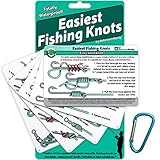
- 12 EASIEST FISHING KNOTS: Portable guide to 12 easy-to-tie fishing knots, selected for their versatility and simplicity. Contains basic knots for freshwater, saltwater, and fly fishing scenarios.
- EASY TO FOLLOW DIAGRAMS: Step-by-step, color-coded diagrams demonstrating how to tie 12 fishing knots, including descriptions and usage tips, perfect for the young or beginner angler.
- POCKET-SIZED AND WATERPROOF: Portable, super rugged, completely waterproof card format is printed on super thick premium plastic stock, making it the ultimate guide for use in wet and punishing environments.
- INCLUDES MINI CARABINER: Includes mini carabiner for clipping your knot cards to your pack, vest, or tackle box, so you always have a knot guide book at your side.
- FANTASTIC GIFT: The versatile selection of fishing knots means this set suitable for kids and scouts, beginners or anyone who wants to brush up on their fishing knots!
The survey also recorded three-spined stickleback at 32.6% of sites, stone loach at 28.0%, minnows at 19.9%, and lampreys at 35 sites, or 13.4%. Pike occurred at 2.7% of sites, dace at 1.9%, perch and roach at 1.2% each, and gudgeon at 0.8%.
Brown trout: Ireland’s most widely recorded river fish
Brown trout were the most widely distributed fish in the 2020 national river survey. They can live in small streams, larger rivers, and systems connected to lakes or estuaries. Some remain close to the stretch where they hatched; others move between rivers, lakes, and coastal waters.
Free tools Windows power users keep installed
One-click scans. No signup required.
This flexibility helps explain why trout occur in both tiny upland burns and larger lowland river systems. They generally need cool, well-oxygenated water, suitable cover, and gravel or other appropriate spawning habitat.
Salmon and sea trout: river fish that depend on the sea
Atlantic salmon
Atlantic salmon spend important parts of their life cycle in freshwater. Adults return from the Atlantic to spawn, while young salmon develop in the river before migrating downstream towards the sea. A river therefore needs more than water: salmon need accessible routes, clean spawning gravel, suitable juvenile habitat, and enough flow and oxygen.
Sea trout
Sea trout are not a separate species. They are the migratory form of brown trout. A sea trout leaves its natal river, grows in the sea, and returns to freshwater to spawn. Inland Fisheries Ireland describes sea trout as native to Ireland and particularly associated with low-productivity rivers, especially on the west coast.
A river may therefore contain both brown trout that remain in freshwater and brown trout that adopt the sea-trout life history. Their appearance alone does not always make the distinction straightforward.
Rank #2
- Used Book in Good Condition
Eels and lampreys: unusual migratory fish
European eel
European eels can live in rivers, lakes, and connected wetlands, but they need a functioning route between inland waters and the sea. Dams, weirs, culverts, and other barriers can restrict their movement. Their complicated migration makes connectivity particularly important: young eels move inland, while mature eels eventually leave freshwater to reproduce at sea.
The European eel is a major conservation concern. The National Parks and Wildlife Service freshwater-fish checklist used in the cited national assessment gives it a Critically Endangered Red List category. That category belongs to the specified assessment and should not be treated as an unchanging label independent of its source or date.
Lampreys
Ireland has three lamprey species associated with freshwater: brook lamprey, river lamprey, and sea lamprey. Routine surveys may record them simply as lamprey because identification can be difficult at some life stages.
Brook lampreys generally complete their life cycle in freshwater. River and sea lampreys are migratory and need access between rivers and the sea. Lampreys use different parts of the river during their life cycle: larvae can live in fine sediment, while adults spawn in gravelly flowing water.
Quick wins for a faster PC:
Repair Windows errors before they cause bigger problemsFix Now →Fix the driver behind crashes, sound loss and screen glitchesFind Drivers →Lampreys are not eels and are not ordinary bony fish. They are jawless fish with distinctive sucker-like mouths. River, brook, and sea lampreys are included among Irish fish with conservation or legal significance in National Parks and Wildlife Service material.
Small fish of streams and shallow margins
Small fish can be easy to overlook, especially in a fast-flowing river. Three-spined sticklebacks, nine-spined sticklebacks, minnows, and stone loach are all part of Ireland’s river fauna.
- Three-spined sticklebacks can use sheltered margins and slower-flowing areas as well as suitable river channels. Their spines and small size make them distinctive, but they are not restricted to ponds.
- Nine-spined sticklebacks are another small stickleback species recorded in Irish freshwater. They may occur in quieter, vegetated, or marginal habitats.
- Minnows are small shoaling fish that can occupy shallow streams, margins, and slower sections of larger rivers.
- Stone loach spend much of their time close to the bottom. Their association with streambeds, shallow rivers, and lake margins means they are often found by looking carefully among stones rather than at the surface.
These fish are important parts of the river food web. They may feed on small invertebrates, algae, or organic material and can themselves become prey for larger fish, birds, and mammals.
Pike, perch, roach, dace, and other coarse fish
Broad, slow-flowing rivers are more likely than cold upland streams to support pike and coarse fish. Deeper pools, submerged vegetation, softer margins, slower currents, and links to lakes provide different conditions from a shallow gravelly trout stream.
Recommended Free Tools
- Pike are ambush predators that favour cover, depth, and places where smaller fish gather.
- Perch are commonly associated with deeper, slower, more productive water and lake-connected systems.
- Roach are coarse fish found particularly in lowland rivers and waters connected to lakes.
- Dace occur locally in Irish rivers. Inland Fisheries Ireland identifies dace and chub as more recent arrivals and designated invasive species in Ireland.
- Gudgeon are small bottom-feeding fish recorded in a relatively small proportion of the 2020 survey sites.
“Coarse fish” is a practical angling and freshwater term rather than a precise biological grouping. Inland Fisheries Ireland includes roach, bream, rudd, perch, and tench among Ireland’s coarse fish, while treating pike as a separate major freshwater group. Carp are also present in some Irish waters. Their occurrence is local and waterbody-specific; they should not be assumed to occur in every Irish river.
Fish that are important but not typical river residents
A complete account of Irish freshwater fish also includes species that are mainly associated with lakes or transitional waters rather than ordinary river channels.
National conservation material covers fish such as twaite shad, allis shad, Killarney shad, pollan, and Arctic charr. Shad are migratory and use rivers for spawning or other stages of their life cycle. Killarney shad is a distinctive Irish form associated primarily with Lough Leane, while pollan and Arctic charr are principally lake-associated in Ireland. They should not be presented as standard fish of every Irish river.
The cited National Parks and Wildlife Service assessment lists Atlantic salmon, twaite shad, Killarney shad, pollan, and Arctic charr as Vulnerable; sea lamprey as Near Threatened; and river and brook lamprey as Least Concern. These are assessment-specific categories, not guarantees about the condition of every individual river population.
Crashes, No Sound, or Screen Glitches?
Random freezes, missing sound and display glitches usually trace back to one bad driver. Find and replace yours safely.Free scan · under a minutePC Slower Than It Used to Be?
A free scan shows the junk files, broken settings and background clutter dragging Windows down - then fixes them in one click.Free scan · Windows 10 & 11Why one Irish river has different fish from another
Fish communities change along a river and between catchments. The most influential factors include:
- Flow and temperature: cold, fast, oxygen-rich water suits trout and young salmon.
- Depth and current: pools and slow reaches provide habitat for pike, perch, roach, and other coarse fish.
- Riverbed material: gravel is important for salmonid and lamprey spawning, while fine sediment can provide habitat for lamprey larvae.
- Vegetation and cover: plants, undercut banks, woody debris, and deeper margins shelter small fish and ambush predators.
- Connectivity: salmon, sea trout, eels, shad, and migratory lampreys need routes between different parts of the catchment and, in some cases, the sea.
- Links to lakes and estuaries: these connections can add species that would be less likely in an isolated upland tributary.
For example, a fast upland tributary might contain mainly brown trout, juvenile salmon, minnows, stone loach, sticklebacks, and perhaps lamprey. A broad lowland river or lake outflow might also contain eel, pike, perch, roach, dace, and gudgeon.
Rank #4
How to identify fish in an Irish river
Identification is easiest when you note the habitat as well as the fish’s shape, markings, mouth, fins, and behaviour. A photograph taken without handling the fish can help, but small fish and lampreys can be difficult to identify confidently in the field.
For a general outdoor reference, a portable laminated freshwater fish field guide covering Britain and Ireland is useful for walkers, families, students, and wildlife observers. It is a regional guide, not an Ireland-only authority, and it is not essential equipment.
Do these 3 things before closing this tab:
1Scan for outdated or missing drivers - takes under a minute2Repair Windows errors before they cause bigger problems3Fix the driver behind crashes, sound loss and screen glitchesFor species-level work—particularly when lampreys are involved—a detailed freshwater fish identification key is the better choice. The Freshwater Biological Association’s identification material is aimed more at serious naturalists and students than casual observers.
Do not remove fish from the river or move them between waters. Wild fish can be injured easily, and moving animals or water between catchments can spread disease and invasive species.
Independent reader supportYour contribution helps us test, update, and keep practical guides available for everyone.Do you need a licence to fish in Ireland’s rivers?
Fishing rules depend on the species, river, season, method, and current year. Salmon and sea-trout fishing requires licensing, while annual regulations and local bye-laws can set quotas, permitted methods, hooks, bait, and catch-and-release conditions.
Anyone intending to fish should check the current Inland Fisheries Ireland and government regulations for the particular river and year. The 2026 salmon and sea-trout rules include river-specific provisions, so a general internet summary is not a substitute for the current official bye-laws. Seeing a fish in a river does not by itself mean that it may legally be caught, retained, or handled.
What’s actually slowing this PC down?
Pick the symptom - the matching free tool is one click away.
How the national survey should be interpreted
Inland Fisheries Ireland’s monitoring programme samples selected rivers, lakes, and transitional waters for information on fish biodiversity, abundance, and age structure. The 2020 river results provide a valuable national snapshot, but they are not a complete census of all Irish rivers.
Best Value

- Fishing Guide for Anglers – A must for avid fishermen in Florida. This fish chart features more than 90 fish and shark’s native to Atlantic waters and boasts rules, regulations, limits, and sizes to ensure a fun and legal catch.
- Waterproof Booklet – Able to withstand saltwater fishing environments and even underwater environments for divers. Our Florida fishing book is tear-resistant and water resistant to ensure it is ready for every outdoor condition.
- Easy-to-Identify Photographs – Our 40-page saltwater fishing guide features large, bright, vibrant pictures, easy-to-read information, and lots of offshore fishing rules and regulations to make it simple for the amateur and avid fisherman.
- Compact and Portable Book Design – This spiral bound booklet is a convenient size so you can keep it in a large tacklebox, backpack, or a boats’ glovebox!
- 100% Made in the USA. Support the USA and small businesses
More recent catchment information reinforces this point. In the 2024 Maigue catchment factsheet, brown trout and salmon were recorded at sampled Loobagh sites, while lamprey, minnow, stone loach, and three-spined stickleback appeared at some sites but not others. The practical conclusion is simple: the national list tells you what may occur in Ireland, while the individual river and river section determine what you are likely to see.
Sources and further reading
This article draws on Inland Fisheries Ireland’s 2020 national river survey and freshwater-fish resources, National Parks and Wildlife Service freshwater-fish and conservation material, the 2024 Maigue catchment factsheet, and current government guidance on salmon and sea-trout regulations. Conservation categories are quoted as categories in the cited national assessment and may change when assessments are updated.
Frequently Asked Questions
What is the most common fish in Irish rivers?
Brown trout are the most widely recorded fish in Ireland’s national river monitoring. Inland Fisheries Ireland found them at 235 of 261 surveyed sites in 2020, or 90%.
Are sea trout a different species from brown trout?
Yes. Sea trout are the migratory form of brown trout, not a separate species. They leave freshwater to grow in the sea and return to a river to spawn.
Do all Irish rivers contain the same fish?
No. The national survey recorded 13 fish species across 261 selected river sites, so its percentages describe monitored sites rather than every Irish river. A river’s fish depend on flow, temperature, depth, habitat, and access to lakes or the sea.
Can you fish for salmon and sea trout in Irish rivers?
Check current official Inland Fisheries Ireland and government rules for the exact river, species, season, and year. Salmon and sea-trout fishing requires licensing, and local bye-laws can change permitted methods, quotas, and catch-and-release requirements.
The Bottom Line
Bottom line: The most widespread fish in Irish rivers is the brown trout, but rivers also support Atlantic salmon, migratory sea trout, eels, three kinds of lamprey, sticklebacks, minnows, stone loach, pike, perch, roach, dace, and gudgeon. Fast upland streams and slow lowland or lake-connected rivers have very different communities, and survey percentages describe sampled sites—not every river in Ireland.
Quick Recap
Product prices and availability are accurate as of the date/time indicated and are subject to change. Any price and availability information displayed on Amazon at the time of purchase will apply.





Leave a Reply